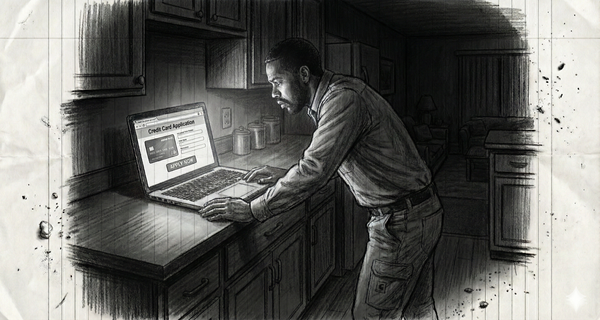
Marcus - Part 1
August, 2030. Austin, Texas
The video call on the laptop connected at 4:47 PM, seven minutes later than scheduled. Marcus was still in his work clothes. He wore Carhartt pants with dust ground into the knees, Timberland boots unlaced and caked with drywall powder, a company shirt that smelled like sweat and solder smoke. He'd dropped his tool bag by the front door when he'd walked in. Jess texted him as he was driving home. She had a work thing. She'd be home late after picking up the kids. Marcus had the house to himself.
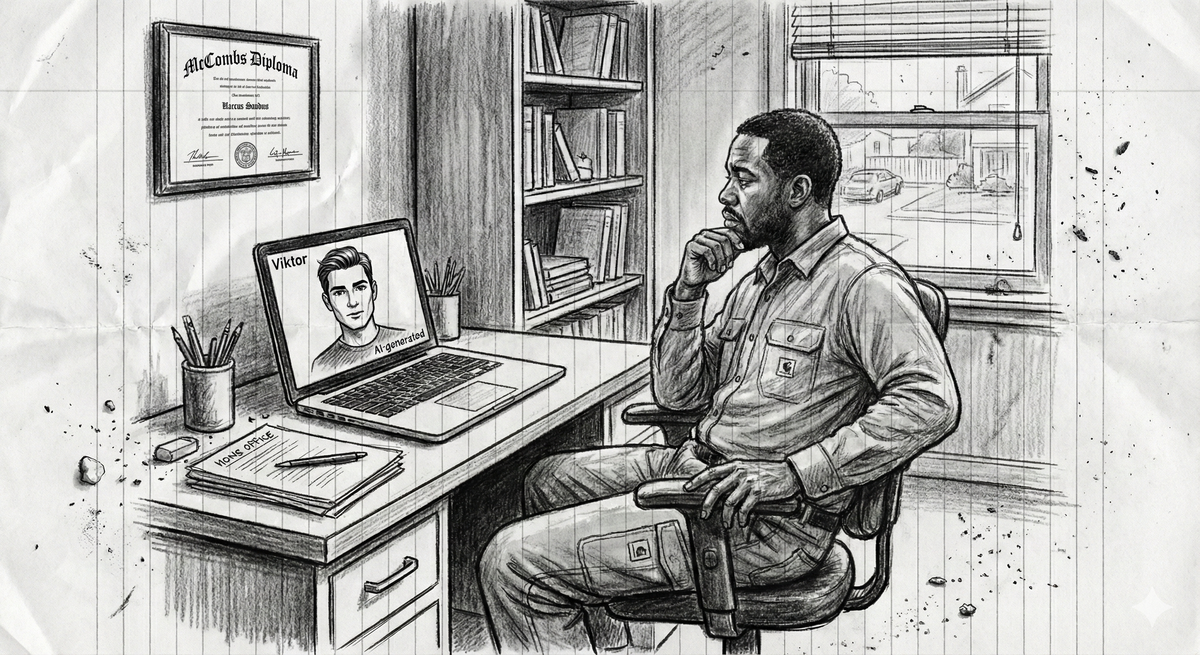
He sat down with a sigh in the old swivel chair of his home office desk. It felt strange. He was never in this room anymore. He glanced up at his diploma on the wall. McCombs: Masters in Marketing and Strategic Communications. His laptop pinged as the video conference interface finished loading. A face appeared on the other end. The name at the top: Viktor. A small watermark on the bottom right-hand of the screen blinked: AI-generated.
"Thanks for making time, Marcus,” said Viktor, appearing to shift in their chair. “I know you just got off shift."
The AI was using a man’s voice. It was warm, if a bit tired, and… was that a New York accent?
"No problem." Marcus leaned back. His shoulders ached. He'd spent the afternoon on a lift, running conduit through a ceiling space that wasn't built for someone his size. Fido, his cobot at the data center, couldn’t reach the spot, so he’d had to do it himself. "What do you need?" Marcus asked.
"You were applicant #2027-25238 in Morrison's AITWA program, one of the early adopters. I'm gathering accounts from people who were heavily impacted by the AI-driven phase shift over the last five years."
Marcus almost laughed. Applicant #2027-25238? What was this?
"What do you want?" Marcus leaned to the side, stretching out a stiff muscle.
"Will you share your journey with me?" Viktor asked.
Marcus looked down at his hands. They were different hands than the ones he'd had five years ago. They were callused across the palms with a scar on his right thumb from where he'd caught it on a j-hook last month. His nails were clean today, but there were thin lines of grease in the small cracks of his fingers that soap couldn't reach.
"Why do you care?" Marcus asked, glancing at the AI watermark.
"Because revisions are being made to the AI Transition Workforce Act. Morrison wants to make it better. As one of the earliest reassignees, your insight and perspective is invaluable. Please. Take your time." Viktor leaned back in their office chair. It creaked. The background they’d chosen was neutral. A simulated office. All tans, blacks, and whites. In the background, bookshelves filled with books and an employee of the month award dated November 2029. A coffee mug sitting on the desk. None of it was real.
Shifting in his chair, Marcus glanced out his home office window at the quiet neighborhood street outside. Janice, his neighbor from two doors down, was out walking her mutt. Clancy, one of his son’s buddies, rode by on a bike. Marcus sighed. All the same but not. Just people going through mundane routines. They were lucky. They hadn't had to rebuild their lives from scratch in their forties.
Marcus cleared his throat. "Well, I got assigned to work on a new project at the data center. As always, we're expanding the cooling systems and upgrading the wiring for the new server racks. But the big project everyone's talking about is tying in the new SMR.
“SMR?” Viktor asked.
Marcus pursed his lips. Viktor knew what an SMR was. That was for the benefit of the auditors. “A small modular reactor,” Marcus explained after taking a beat. “Can you believe they built a custom nuclear reactor just for the data center? They fired it up last week, and it purrs like a kitten. Now we’ve got to integrate it into the center's power grid."
The irony wasn't lost on him. Every day, he pulled wire, bent conduit, and installed breakers to feed electricity into the power-hungry machines that tore his life apart just a few years before.
Viktor leaned forward on the screen and caught Marcus’s gaze. "When did everything change for you?"
Marcus closed his eyes. Of course. That’s what the AITWA wanted to know. The question pulled him back five years. He could see the conference room at Ventus Tech: gray walls, fluorescent lighting, and a small wood laminate conference table. The whole team was there, Lauren laughing sardonically, Vinny excited but skeptical, and everyone else. The demo was projected onto a ceiling-mounted pull-down screen. Ninety seconds. Ninety seconds that rewrote his life.
"March 2025," he said. "That's when they announced the new platform."
---
March 2025
The conference room smelled of burnt coffee and dry-erase markers. Eight people from the analytics team were crammed around a table built for six. Marcus sat near the back, laptop open, half-listening as Geoffry, the chief product officer, ran through the agenda. It was the usual stuff: quarterly roadmap, product updates, budget adjustments. Same meeting they had every quarter, just a different slide deck.
Geoffrey, everyone called him Jeff, clicked to a new slide.
SYNTHESIS: Next-Generation Market Intelligence
"Now this is something I’m really excited about," said Jeff.
Marcus sat up. Jeff's neck was red and blotchy, and he wouldn't look anyone in the eye. Why was he so uncomfortable?
Jeff went on. "We've been testing a new AI-powered platform. It’s going to transform how we do market analysis."
Marcus recognized Jeff's tone. Leadership had already made a decision. Jeff wasn't here to discuss or deliberate. This meeting was theater.
Lauren, sitting across the table from Marcus, caught his attention with a subtle nod before rolling her eyes and smirking. Vinny, one of their younger team members, was leaning forward on the conference table. They'd been through three "transformative" AI tools in the last two years. AI was the new, trendy business keyword that everyone in the C-suite wouldn’t stop talking about. But none of the platforms stuck. They were all gimmick and no substance.
Jeff opened a browser window. "Let me show you what it can do."
The interface was just a simple text box. Jeff typed: “Generate a competitive analysis report for Q1 2025, focusing on customer retention metrics and competitor pricing strategies in the SMB segment.”
He hit enter.
There was a brief pause as an hourglass turned over and over on the screen. Someone groaned. This was supposed to be transformative? Thirty seconds. Nothing. Jeff squirmed as all eyes darted between him and the screen. Sixty seconds. Lauren barely stifled a laugh. They were all thinking it. What a waste of time. The red patch on Jeff's neck got brighter, and his light blue shirt was getting darker with sweat around his collar. Eighty seconds. The hourglass disappeared, and the screen filled with text. Pages of paragraphs scrolled past in real-time as citations pulled from internal documents and corresponding infographics arranged themselves into a neat, well-organized report. Done. Ninety seconds.
Jeff scrolled through it. There was an executive summary at the top, followed by a ten-page deep dive. At the end was a recommendations section with clear action items. The formatting was spot on. It was comprehensive and easy to read. It pulled all the company data from Salesforce, Customer surveys, competitor websites, and reports from industry analysts. Everything was there in one coherent narrative.
"Oh," someone said. It was like the air had been sucked out of the room. Jeff rubbed his neck.
Marcus stared at the screen. The writing was clean and professional. The program made accurate connections. They weren't all obvious at first, but on review, it all made sense. No hallucinations, and the recommendations were reasonable. It wasn't brilliant, but it was solid. This level of work would have taken him at least two days to produce.
And there: third paragraph from the top. Marcus’s chest tightened: “Customer sentiment analysis reveals a friction point in the onboarding experience, particularly for users transitioning from legacy systems.”
The phrasing was eerily familiar. Hadn't he written something like that in last year's Q3 report?
"Questions?" Jeff asked. He was looking back and forth from the window to the screen. Their office was downtown, offering a sweeping view of Lady Bird Lake and the Auditorium Shores park on the other side. Jeff wouldn’t look at anyone in the room.
Lauren raised her hand. "How accurate is it?"
"87% out of the box," Jeff said. "It'll get better as it learns."
"So we're expected to train it?" another team member asked, not masking their disdain.
"Exactly. Think of it as an intern."
Something cold settled in Marcus's stomach. Jeff was deflecting. This was an intern who didn't sleep, didn't need benefits, never called out sick, or asked for raises. 87%. That was the worst it’d ever be.
"It'll make everyone more efficient," Jeff said, now scrolling through the report with the projector’s remote. "We’ll get insights faster, which will free up time for more strategic thinking. With Synthesis doing a lot of the busy work, we can bring on more clients without increasing your workload."
Efficient. Marcus knew that word. He'd been through enough of these meetings to recognize the euphemism. Efficient meant fewer people doing more work. Efficient meant shrinking the team.
Lauren guffawed. "It's just another stochastic parrot doing next-token prediction. This thing doesn't actually think. I bet it costs a fortune, and in six months you'll have us trying something else. Why don't you just let us do our jobs?"
Marcus wanted to agree, but as the senior member of the analytics team, he kept his mouth shut. A few people around the table nodded. Vinny was taking a picture of the screen with his phone.
"Any other questions?" Jeff asked.
"What was it trained on?" Vinny asked.
Jeff shifted his weight. "Some public datasets and an archive of internal documents. Company reports, past analyses, industry benchmarks. Standard stuff."
"So our reports?" Marcus asked. "My reports?"
"Among others,” said Jeff. “That's how it learns our house style, our methodology. It’s what makes it unique to us."
There it was. They’d already fed the beast every report he'd ever written for the last twelve years, studied Marcus’ thinking, the team’s thinking. It could already do two days of work in ninety seconds. The projector’s fan kicked in as the machine heated up, spinning up with a loud whir that drowned out the sound of the traffic in the streets down below.
That was it for the meeting. Jeff was the first to leave. He had another meeting. Everyone else filed out, quiet or murmuring amongst themselves. Marcus stayed in his seat, staring at the now-blank projector screen.
Lauren paused at the door. "You coming?"
"Yeah. In a minute."
She lingered. "It's just another app, Marcus. They're always hyping up this stuff. Remember that predictive analytics platform they spent $300K on last year? We stopped using it after three months."
"Yeah,” Marcus stood up. “You're probably right."
But he knew she wasn't. This was different. This time, the tool actually worked.
---
Later that day, Marcus drove home in a fog. Austin traffic was its usual snarl. Cars were bumper to bumper down I-35 as everyone tried to get off at the same exits. Marcus sat there, engine idling, hands on the wheel, mind drifting.
Ninety seconds. That's all it took.
His phone buzzed. Text from Jess: “Can you grab milk on the way home? We're out.”
He pulled into the HEB parking lot, went through the motions. He grabbed a cart, walked through the aisles on autopilot. He grabbed milk, cereal, and a few other things.
At checkout, the cashier smiled at him. "Did you find everything?"
"Yeah," said Marcus automatically. "Sure."
Social courtesy done, they finished the interaction in silence.
Marcus loaded the groceries into the trunk of his old Honda Civic. He sat there, in the driver's seat, inside the funk of a vague unease. With his hands on the steering wheel, the engine idling, Marcus watched the passersby. A young couple arguing over their shopping list. An elderly man moving slowly with a cane. A mother wrestling two kids and a cart full of groceries.
He started the car and drove home.
---
Later that evening, Marcus sat at the dining table with his wife and kids. Dinner was oven-roasted chicken with rice and stir-fried vegetables. Nina, their eight-year-old, was chattering about a boy named Tyler who'd eaten a snail at recess. Caleb, eleven, was separating the peas and rice on his plate into two piles as he scrolled through something on his tablet.
"Caleb, no devices at the table," said Jess, shaking some salt over her rice.
Caleb let out a loud groan but did as he was told, setting the tablet down on the white, tiled kitchen counter behind him.
"How was work, babe?" Jess asked Marcus.
Marcus looked up at Jess. She was radiant, as always. The way her hair framed her face. Her smile wrinkles. Those bright, piercing eyes. "Fine,” he said. “Good even."
"Another meeting?" Jess said with a sympathetic smile.
Marcus nodded and offered a wan smile.
Nina was looking at him. "Are you sad, Daddy?"
Marcus was caught off guard. "No. No, I'm not sad, kiddo. Just tired."
"You’re always tired," she said, taking a bite of chicken.
Marcus forced a smile. "That's because work is tiring."
"Then why do you do it?" Nina was speaking with her mouth full.
Out of the mouths of babes. Marcus sighed. "Because that's how we pay for this house, and your sports, and everything else we need."
Nina nodded and went back to her story about Tyler and the snail. It was crunchy. No surprise there. And salty. Well, that was surprising. Tasted like chicken. Marcus stopped cutting his chicken. He wasn’t hungry.
Marcus felt Jess’s eyes on him. She knew something was off, but she didn’t want to push. He was thankful for that. He wasn’t even sure why he was feeling so off. But he felt unsettled, like the ground was shifting under his feet. He took another bite and pushed the feeling away. Everything was fine. They’d be fine.
---
October 2025
Marcus was working from home, reviewing reports. It was a little over six months since the Synthesis announcement, and Marcus's team of eight was down to three. Five people were let go in two rounds of "restructuring." The first round had taken two junior analysts and a mid-level researcher. The second round had taken Lauren and a senior analyst Marcus had worked with for seven years.
Lauren's last day was in July. She'd packed her desk in silence, her eyes re,d but she refused to cry, refused to make a scene. Marcus walked her to the parking lot.
"They're going to keep cutting," she'd said, hefting a cardboard box of personal items into her trunk. "You know that, right?"
Marcus had set the bag he was carrying next to the box. "Maybe," he’d said, clumsily. He was never good at that kind of thing. He remembered it was over 100 degrees out that day, and the parking lot was baking. They were both sweating, even though they’d only been outside for a few minutes.
"You should start looking,” Lauren said, slamming the trunk of her green Jeep shut with a certain finality. “Find something new. Screw these guys."
Marcus had nodded, but he didn’t do anything. He was the company’s senior analyst. They needed him. They needed his experience, his institutional knowledge, his relationships with clients. That couldn’t be replaced.
That was three months ago, and now the team was down to three. It was down to Marcus, Vinny, and a product manager who'd been reassigned from another department. Marcus wasn’t generating his own reports anymore. These days, he was spending all his time "auditing" the Synthesis reports. No one in leadership would call it training, but Marcus knew that’s what he was doing. He spent his days reviewing the AI's reports, correcting its mistakes, and providing feedback. Leadership wasn’t wrong. His team of three was already out-producing the old team of eight.
Now, his entire day was spent teaching the machine how to replace him.
And he was successful, too. The outputs were getting better. There were fewer errors, more sophisticated analyses, more accurate predictions, and it was making connections even Marcus missed. Sometimes he’d be reading one of the Synthesis reports and forget, just for a moment, that he hadn't written it himself. The phrasing was his. The structure was his. Even the way it built arguments and drew conclusions, all of it was his methodology, but perfected and scaled.
Among other things, his calendar was emptier these days. But it didn’t matter if Jeff kept rescheduling their 1-on-1s. That was a good thing, right? That meant he had more time for their growing client base. The company was doing better than ever. This quarter, they’d reported a 65% increase in revenue compared to the previous year.
No new meetings were scheduled. This was no surprise. The company had just moved to work from home as part of a new effort to keep the company as lean and profitable as possible.
Marcus was working at his home office desk, a metal and glass piece of IKEA furniture, reviewing another Synthesis report. It was a market analysis for a new product line. He scrolled to the bottom of the report, looking for his name in the contributors section. It wasn't there. Just: “Generated by Synthesis | Reviewed by M. Okonkwo.”
Reviewed. Not written, not authored. Reviewed. His stomach turned. He was just quality control now, wasn’t he? A human spell-checker making sure the real author didn’t make any obvious mistakes?
Marcus closed his laptop and sat in the quiet, surrounded by the trappings of his career, his education. His diplomas were on the off-white wall above his desk. A bachelor's from UT. A master's from McCombs. His OnCon Icon award. His company's recognition plaques. He was the employee of the year back in 2023.
All those achievements, all those hours of hard work, those late nights studying, all that student debt to get those pieces of paper on the wall… for what? For it all to turn into decoration? He put his head in his hands and sighed.
Marcus tried to shake off the thought. Through the door, Marcus heard Jess talking to the kids downstairs. Murmurs about scheduling a game that weekend, about a project at school. The sun was setting outside on a dry fall evening.
He hadn't told Jess about the job cuts. What would he even say? That he was worried? That he felt like he was standing on quicksand?
No. Better to wait. Better to see how things played out.
---
January 2027
2026 came and went before Marcus knew it. Vinny was gone. He’d moved to San Francisco for a startup. The product manager was shuffled back to the product creation team. It was a cold Tuesday morning with flecks of frost clinging to the edges of the windowpanes of Marcus’ home office. Even though he was working from home, Marcus still dressed in his work clothes: a button-up and slacks. He couldn’t shake the habit. A steaming mug of coffee sat on the glass desktop next to his keyboard. He was trudging through his queue of Synthesis reports when Jeff pinged him on Slack.
Jeff: Hey Marcus, can you jump on a quick call?
Marcus's stomach dropped. Jeff hadn’t called a meeting in months.
He clicked the video call link, and Jeff appeared on screen with a fake tropical island as his background. Jeff looked tired, older than usual.
"Hey, Marcus." Jeff rubbed his face. "Thanks for hopping on."
"How can I help?" Marcus asked.
Jeff took a breath. "Look, I'm going to be direct. We're doing another restructuring. The analytics department is being consolidated. Synthesis has proven capable of handling all of our day-to-day analyses. The product managers are going to review the outputs."
Marcus nodded slowly. His hands felt clammy.
"You've been a crucial part of this team for..." Jeff glanced at something off-screen.
"Sixteen years,” Marcus managed.
“Really?” Jeff’s eyes widened. “Geez. That's…,” he groaned as he looked off-screen. “That’s incredible.” Jeff sat more upright in his chair, the simulated palm trees bending in a breeze behind him. “Well, with the way things are going, we're moving in a different direction. Your role is being eliminated."
There it was. Clean and simple.
"When?" Marcus heard himself ask.
"Today is your last day. HR will reach out about severance and benefits. You'll get three months' pay, which I pushed for, by the way. I wanted to make sure you were taken care of. And obviously, I'll be a strong reference for whatever comes next."
Marcus was frozen. Three months. Ninety days to find a new job. A lump was forming in his throat. Was that enough time? His heart was racing now. Lauren and Vinny were still looking. But he was the team lead. Surely that would make his search easier.
"Marcus?" Jeff said. "You still there?"
He shook himself back into focus. "Yeah. Yeah, I'm here,” said Marcus
"I'm really sorry, man,” Jeff went on. “This isn't personal. It's just... the way things are going. You understand."
He understood perfectly. Marcus understood that he'd spent sixteen years expanding his industry expertise, building institutional knowledge, and being loyal to a company that what? That decided profits mattered more than people? It was all so damn cliche he could scream.
"Is there anything I can do to help with the transition?" Jeff asked.
Marcus flinched. Transition. Jeff was just posturing to make himself feel better about having laid off an entire department. There wasn’t anything Jeff could do. He wasn’t going to find Marcus a job. No. It was shallow and performative, and Marcus couldn’t stand it.
"No," Marcus said, his lips tight. "We're good."
"Okay. Well. HR will be in touch. And Marcus? Seriously, you're a great analyst. You'll land on your feet."
Jeff ended the call, and the palm trees faded to black. Marcus sat there, staring at his laptop screen, at the report he'd been reviewing on the other screen. His cursor was still blinking in a comment box where he'd been about to note a minor correction.
Marcus closed the laptop. He took a deep breath and realized his jaw was clenched so tight his teeth hurt, and his whole body was stiff.
He sat there. Outside his home office, the house was quiet. Jess was at work. The kids were at school. It was just him, alone with the fact that his career was over. It didn’t feel real.
He should call Jess. Should tell her. Should start making a plan.
Instead, he sat there. Minutes passed. An hour? Time felt strange, elastic.
Finally, Marcus stood up. He walked downstairs. In a daze, he grabbed his keys, got into his car, and started driving with no destination in mind. He couldn’t be at home. He needed to move.
Marcus ended up in the Target parking lot, sitting there with the engine off, watching people go in and out. A young woman with a baby in a carrier. An elderly couple moving slowly, one with a walker. A teenager, probably cutting class.
All of them had somewhere to be. Something to do. Marcus had nothing.
His phone buzzed. It was a text from Jess: “How's your day going?”
He stared at the message, his finger hovering over the screen.
A mother with twin infants, both riding in the shopping cart, strode by. A young twenty-something rode past on a motorcycle, circling for a parking spot closer to the store. And there, on the far end of the parking lot, a disheveled man who might have been Marcus’s age, tossed something from a dumpster into a shopping cart filled with junk.
“Good,” Marcus typed. “Busy with some client stuff. How about you?”
Before he could second-guess himself, he hit send.
---
That evening, Jess came home to find Marcus in the kitchen, making dinner. He'd picked up groceries: pasta, ingredients for a marinara sauce, and a baguette. The house smelled of boiling pasta, searing garlic, and roasted tomatoes.
"Hey," Jess said, dropping her bag by the door. "What's all this?"
Nina and Caleb came thundering in behind her, pushing and shoving each other to be the first up the stairs.
"Thought I'd make dinner,” said Marcus. “You deserve a night off."
She smiled and came around the kitchen counter to kiss him on the cheek. Marcus could smell her perfume over his cooking. Jasmine. "You're sweet,” she said. “What's the occasion?"
Marcus focused on stirring the sauce. "Well, I, uh, got some news today."
Jess perked up. "Yeah? Good news?"
"Yeah. They're promoting me to Senior Analyst. It’s more of a strategic role, less day-to-day stuff. A bit more money, better title."
The lie came out smooth, easy, almost like he'd been planning it.
Jess's face lit up. "Marcus! That's amazing! Oh my God, this is exactly what you've been working toward!"
She hugged him, and he hugged her back, his hands shaking slightly.
"I'm so proud of you," she said into his shoulder. "You've worked so hard for this. You deserve it."
"Thanks," Marcus managed.
She pulled back, still smiling, searching his eyes with her own. Seeing something, Jess’s brow furrowed. "Are you okay?”
Marcus felt his heart stop. “Yeah. Of course.” He turned to stir the sauce. “It’s just a lot of responsibility. I’ve got a lot to process.”
“Well,” Jess said, “we should celebrate. Why don’t we go out this weekend? I’ll get my mom to watch the kids."
"That sounds great."
"And we should sign the kids up for those summer camps they've been asking about. We can afford it now, right? With the raise?"
Marcus's throat tightened. "Right. Yeah. We can do that."
Jess kissed him again and went upstairs to change. Marcus turned back to the stove, watching the sauce bubble. He caught a whiff of something burning.
What had he done?